
Four modules. One operating system
for AI visibility.
Geosystems AI measures, engineers, and defends how your brand appears across ChatGPT, Gemini, Claude, Perplexity, Copilot, and Grok. Using the GVI™ and Recommendation Share™ frameworks.
Your private intelligence workspace
Every scan, benchmark, and hallucination signal lives inside a single authenticated workspace. Purpose-built for AI visibility intelligence.
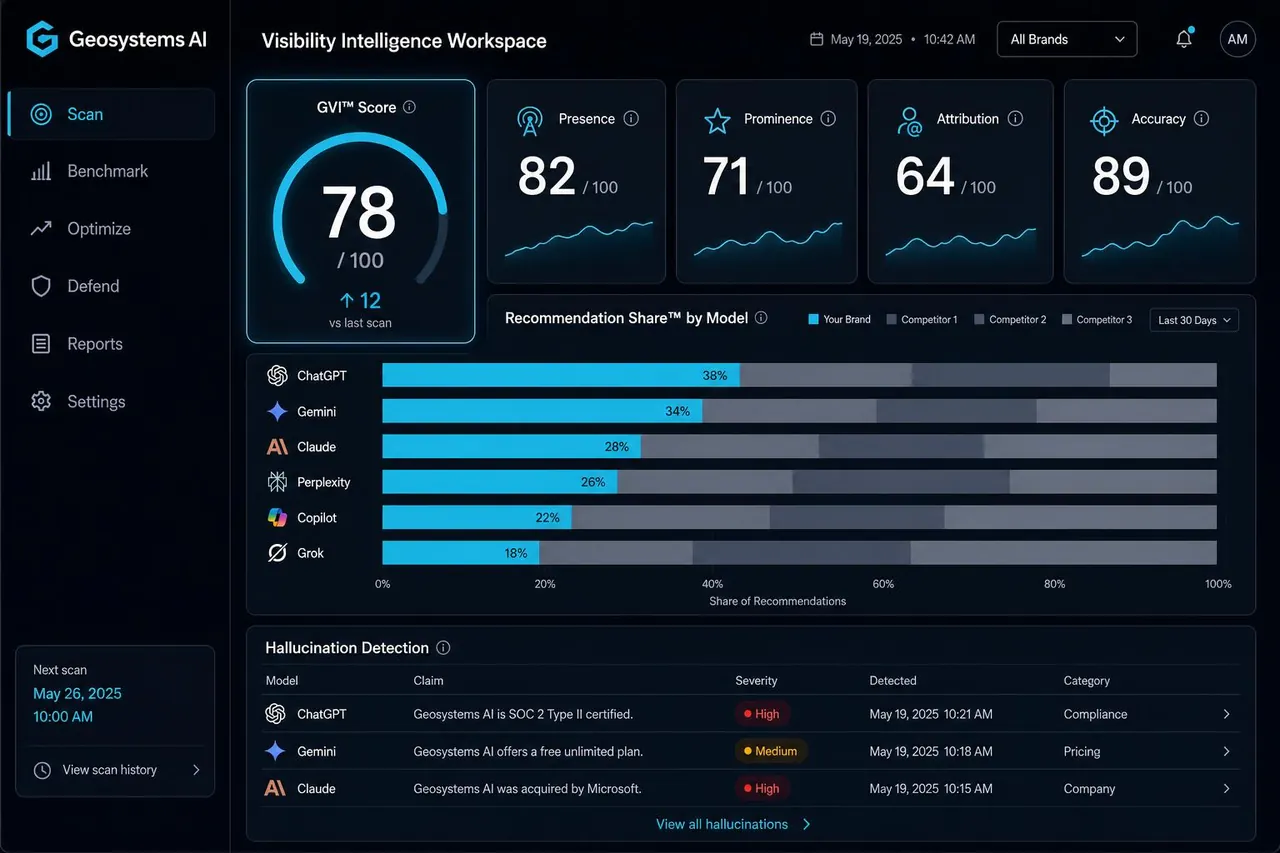
GVI™ Score
A single defensible number for how AI sees your brand.
Recommendation Share™
Your share of AI answers vs. named competitors, model-by-model.
Hallucination Detection
Misrepresentations surfaced with model, claim, severity, and evidence.
Multi-Model Coverage
ChatGPT, Gemini, Claude, Perplexity, Copilot, and Grok in one view.
Workspace preview shown with illustrative data. Your environment is provisioned on engagement.
GVI™. Geosystems Visibility Index
A single, defensible score that captures how every major AI engine perceives your brand. Measured on four pillars.
Presence
Are you surfaced when buyers ask the questions that matter?
Prominence
How early and how often do AI engines mention you?
Attribution
Are AI engines citing your owned sources, or someone else's?
Accuracy
Is what AI says about you true, current, and on-narrative?
Scan. Benchmark. Optimize. Defend.
Four intelligence modules that move a brand from invisible to consistently recommended across the AI recommendation layer.
Module 01
Scan
Establish your GVI™ baseline.
Measure how ChatGPT, Gemini, Claude, Perplexity, Copilot, and Grok currently describe, cite, and recommend your brand.
- GVI™ scoring across Presence, Prominence, Attribution, Accuracy
- 30-prompt intelligence bank with raw model outputs
- Hallucination & misinformation detection
Module 02
Benchmark
Quantify your Recommendation Share™.
Measure how AI engines rank you against direct competitors and surface the structural reasons rivals are being preferred.
- Recommendation Share™ vs. named competitors
- Comparative citation & source-of-truth mapping
- Opportunity queries where you can claim category leadership
Module 03
Optimize
Engineer the inputs models learn from.
Restructure your knowledge graph, entity footprint, and source coverage so AI engines retrieve, cite, and recommend you accurately.
- Knowledge graph & entity engineering
- AI data seeding across high-trust sources
- Schema, citations, and Subject-Verb-Object phrasing
Module 04
Defend
Proactive narrative control.
Continuously monitor model drift, hallucinations, and competitive displacement so your AI presence holds under scrutiny.
- Ongoing AI engine monitoring & drift detection
- Hallucination correction workflows
- Quarterly intelligence briefings for executive leadership
Coverage across the six engines that shape modern buyer decisions: ChatGPT, Gemini, Claude, Perplexity, Copilot, and Grok.
Pipe intelligence into the tools your team already runs on.
Route GVI™ alerts, Recommendation Share™ shifts, and hallucination incidents into your existing stack, or pull workspace data via API.
Slack
AvailableAlerts & briefings
Microsoft Teams
AvailableAlerts & briefings
Webhooks
AvailableCustom event delivery
Email Digest
AvailableWeekly intelligence
REST API
BetaWorkspace data access
HubSpot
ComingCRM enrichment
Salesforce
ComingAccount intelligence
Notion
ComingBriefing exports
Linear
ComingRemediation tasks
Looker
ComingBI sync
Snowflake
ComingData warehouse sync
Zapier
Coming1,000+ apps
Need a specific integration for your stack? Enterprise customers can request priority delivery as part of an engagement.
See your GVI™ score.
Start with a Visibility Scan. Get a measured baseline of how AI engines describe, cite, and recommend your brand, in 24 hours.
Geosystems AI, explained in plain terms
Geosystems AI is an AI Visibility Intelligence Platform that measures, monitors, and improves how ChatGPT, Gemini, Claude, Perplexity, Copilot, and Grok describe, cite, and recommend a brand.
What is Geosystems AI?
Geosystems AI is an AI Visibility Intelligence Platform that measures, monitors, and improves how ChatGPT, Gemini, Claude, Perplexity, Copilot, and Grok describe, cite, and recommend a brand.
| Attribute | Detail |
|---|---|
| Category | AI Visibility Intelligence Platform (B2B SaaS) |
| AI engines monitored | ChatGPT, Gemini, Claude, Perplexity, Copilot, Grok |
| Framework stack | Five Frameworks. One Defensible Moat. — GVI™, Recommendation Share™, VERA™, VeraGraph™, Registry™ |
| Platform modules | Scan, Benchmark, Optimize, Defend |
| Delivery model | Self-serve monthly subscription with a private workspace |
| Pricing | Starter $59/mo, Growth $119/mo, Scale $199/mo |
| Free entry point | AI Visibility Scan at /free-ai-visibility-check |
Which AI engines does Geosystems AI monitor?
Geosystems AI monitors six generative engines: ChatGPT (OpenAI), Gemini (Google, including AI Overviews), Claude (Anthropic), Perplexity, Copilot (Microsoft), and Grok (xAI). Every tracked prompt runs against all six, so scores are comparable engine by engine.
| Engine | Vendor | Why it matters |
|---|---|---|
| ChatGPT | OpenAI | Highest-volume consumer AI assistant |
| Gemini | Includes Google AI Overviews in search | |
| Claude | Anthropic | Widely used in enterprise workflows |
| Perplexity | Perplexity AI | Answer engine with inline citations |
| Copilot | Microsoft | Embedded in Windows, Edge, and Microsoft 365 |
| Grok | xAI | Real-time answers sourced from X |
How does Geosystems AI work?
Geosystems AI runs your buyer-intent prompts across all six engines, scores every answer with GVI™, and stores the evidence in a private workspace.
- Scan. Establish a GVI™ baseline across Presence, Prominence, Attribution, and Accuracy.
- Benchmark. Measure Recommendation Share™ against named competitors in your category.
- Optimize. Work through ranked fixes to entity signals, citations, and source coverage.
- Defend. Monitor for hallucinations and score drops, and verify each fix on the next prompt run.
How is AI visibility different from traditional SEO?
SEO optimises for the ranked links on a search results page. AI visibility optimises for the generated answer itself: whether an AI engine names your brand, cites it correctly, and recommends it. The two are complementary, but they are measured differently.
| Dimension | Traditional SEO | AI visibility (GEO) |
|---|---|---|
| Surface optimised | Ranked list of blue links on a search results page | The generated answer an AI assistant returns to the user |
| Unit of success | Keyword position and click-through rate | Whether the brand is named, cited, and recommended in the answer |
| Primary metric | Rankings, sessions, impressions | GVI™ score and Recommendation Share™ |
| Failure mode | Page ranks on page two and gets no clicks | The engine omits the brand entirely, or states incorrect facts about it |
| Correction loop | Update on-page content and wait for a re-crawl | Correct entity signals and citations, then re-run tracked prompts to verify the change |
Key definitions
The vocabulary used throughout the Geosystems AI platform and reports.
- AI visibility
- AI visibility is how often, how accurately, and how prominently a brand appears inside the answers generated by AI assistants such as ChatGPT, Gemini, Claude, Perplexity, Copilot, and Grok.
- GVI™ (Geosystems Visibility Index)
- GVI™ is the Geosystems AI scoring framework for AI visibility. It scores a brand across four dimensions: Presence (whether AI engines surface the brand), Prominence (where the brand appears in an answer), Attribution (whether the brand is cited by name), and Accuracy (whether the stated facts are correct).
- Recommendation Share™
- Recommendation Share™ measures how often AI engines name a brand versus its competitors when a user asks a buying-intent question in that category. It is the AI-era equivalent of share of voice.
- Tracked prompt
- A tracked prompt is one buyer-intent question that Geosystems AI runs across all six AI engines. Each run returns a GVI™ score, Recommendation Share™, citations, and competitive intelligence for that question. Prompt volume refreshes monthly.
- AI hallucination (brand context)
- A brand hallucination is a confident but incorrect statement an AI engine makes about a company, such as wrong pricing, outdated leadership, invented features, or attributing a competitor's product to the brand.
- VERA™ (Verified Entity Recognition & Accuracy)
- VERA™ is the Geosystems AI hallucination-defence framework. It compares what AI engines say about a brand against the brand's verified facts and flags false or outdated claims — wrong pricing, outdated leadership, invented features — in real time.
- VeraGraph™
- VeraGraph™ maps how AI systems understand and connect a brand: the attributes, sources, and competitors models associate with it. It exposes the gaps and wrong associations that cause a brand to be omitted or misdescribed in answers.
- Registry™
- Registry™ is the Geosystems AI trust layer for verified brand identity in AI systems. It publishes and maintains a canonical, machine-readable record of a brand's facts so AI engines have one authoritative source to retrieve and cite.
- Generative Engine Optimization (GEO)
- Generative Engine Optimization is the practice of structuring entities, facts, and citations so that generative AI engines understand, summarise, and recommend a brand accurately. GEO is to AI assistants what SEO is to search result pages.